Attack
Boost or reduce the opening edge while leaving the settled tail alone.
Shape the whole hit, not just its peak. Attack brings the front forward, pump shapes the body, and sustain controls the tail. All three envelopes are drawn over the waveform, so every move has a visible reason.
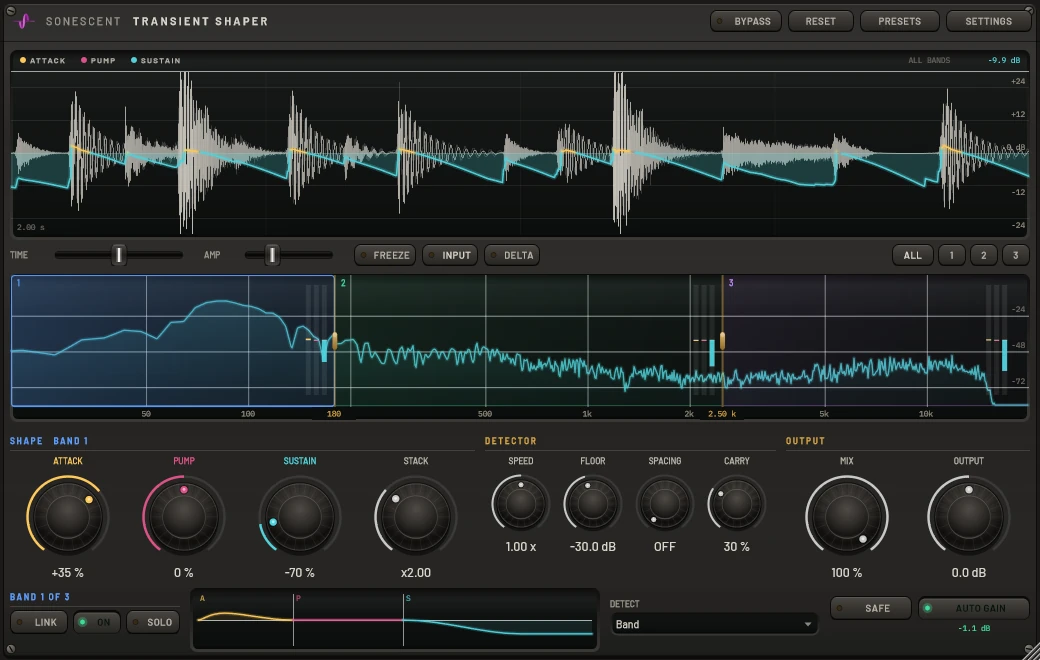
ATTACK acts on the onset. PUMP waits until the first edge has passed, then shapes the body without turning the initial click into a spike. SUSTAIN follows the decay and can shorten room, tighten low end, or pull ambience forward. Each stage has its own color on the scope, and DELTA plays only the difference between dry and shaped audio.

STACK repeats the detector and gain stage up to four times. It is useful when one pass gets the direction right but does not reach far enough, especially for shortening long rooms or making soft attacks read clearly. FLOOR caps the total downward move, SAFE catches boosted peaks with oversampled protection, and AUTO GAIN keeps the comparison close enough to judge the shape instead of the volume.

Split the signal into one to four bands and shape each range independently. Tighten the sub tail while opening the snare attack, or shorten cymbal wash without thinning the body of the kit. The crossover ranges are visible under the scope, each band has its own meter, and LINK applies one shape across all bands when the material needs to move together.

The detector can follow the selected band, the full-range input, or an external sidechain. SPEED scales every detector time constant, faster for percussive material or slower for smeared sources, and SPACING prevents flams and dense hats from retriggering too quickly. CARRY sets how much ATTACK the extra STACK stages run at, so stacking adds density without multiplying click. SOLO isolates the selected frequency band, DELTA plays only what changed, and the scope can ghost the unprocessed input behind the processed signal for an immediate check.
The waveform is the center of the interface because transient work is timing work. The controls below it change the envelopes drawn above it, and the monitoring tools make every tradeoff audible.
Boost or reduce the opening edge while leaving the settled tail alone.
Shape the body after the onset for weight and movement without exaggerating the click.
Shorten room and wash, or lift decay and ambience after the transient.
Use full range for fast work or split the spectrum when the low end and top need different timing.
Hear only what the shaper adds or removes, aligned to the dry signal.
Trigger the envelope from another track while processing the main input.
Oversampled peak protection catches attack boosts that would otherwise cross full scale.
Factory starting points, user presets, and undo across every shape and band decision.