A gate that shows you exactly what it took away.

Gate, downward expander and ducker in one plugin, with a keyed trance gate built in. The display draws what was kept, what was removed and what the detector heard on one decibel scale, the threshold is a line you drag straight on it, and one button lets you hear everything the gate is taking out before you commit to it.

30-day free trial · VST3 (+ AU on Mac) · 3 machines per license
By buying, you are also subscribing to marketing emails from Sonescent: production tips, product updates and offers. You can unsubscribe at any time. Privacy policy
Read the guide →
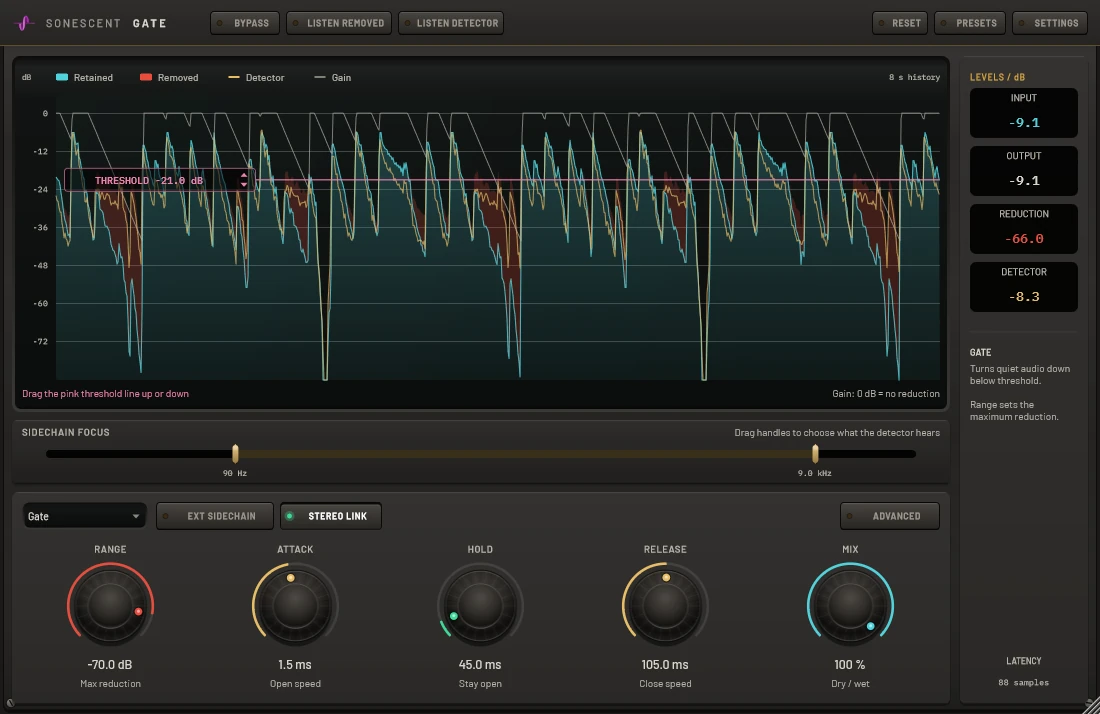
Sonescent Gate on a dry drum loop: eight seconds of level history with the kept signal in teal, the removed gaps in red below the pink threshold line, the detector in gold and the gain trace in grey, above the five main knobs
The display

Kept, removed and heard, on one scale.

The top of the window is a level history in decibels. What passes through fills in teal, what the gate takes out sits above it in red, the gold line is what the detector hears, and the grey line is the gain the gate is applying, so a close, a hold and a release all have a shape you can read. Every line uses the same scale on the left, so the pink threshold line means what it says: anything the detector puts above it opens the gate. Drag the line to set it; grabbing it never makes it jump. Choose eight, four or two seconds of history, and read input, output, reduction and detector level at the side.

The expander on a lead vocal over a steady noise floor: the sung phrases pass untouched while the noise between them is lowered, shown in red, with the gain trace stepping down between phrases
Three modes

Gate it, ease it down, or make room.

GATE turns everything below the threshold down by RANGE, from a gentle 10 dB tidy-up to a full 80 dB cut. EXPANDER lowers quiet material in proportion: at 2:1, a sound 6 dB under the threshold comes out 12 dB under, which keeps the ends of words and the tails of notes natural while room noise and headphone spill drop away. DUCK works the other way round: while the detector is above the threshold the track turns down by RANGE, and it comes back when the detector falls. HYSTERESIS sets a lower closing level so a signal hovering at the threshold cannot chatter, and HOLD keeps the gate open for a set time after the signal drops.

Duck mode on a bass keyed from a drum loop: the gain trace pulls the bass about 10 dB down as the drums hit and lets it back up in the gaps, with the sidechain focus narrowed to 30 to 250 Hz so the low drums drive it
Keyed and rhythmic

Let another track open it.

Turn on EXT SIDECHAIN and route any track into the plugin's sidechain input: a kick can open a bass, a voice-over can duck the music, or a short 1/8-note hat or click pattern can chop a pad into a trance gate. A readout beside the button says whether the key is arriving, silent, or not connected, and if you load a keyed preset without routing anything, the display tells you why the track has gone quiet instead of leaving you guessing. A mono track keyed from a stereo source listens to both channels of the key.

The keyed trance gate preset on a chord part: a regular 1/8-note click pattern in the sidechain opens the gate in hard square steps, the kept chords in teal and the removed gaps in red
Simple first

Five knobs until you need the rest.

The main view is RANGE, ATTACK, HOLD, RELEASE and MIX, each labelled with what it does in the current mode, and the threshold lives on the display. ADVANCED adds a numeric threshold, ratio, hysteresis, lookahead and the two sidechain focus frequencies, and the plugin remembers which view you prefer. Every control explains itself on hover, and values can be typed the way they read: 8k, 1.5 s or 30 dB.

The advanced view: threshold, range, ratio, hysteresis, attack, hold, release, lookahead, focus low, focus high and mix knobs under the level history and sidechain focus rail

Every mechanism real, measurable, and visible.

Nothing here is named after gear it imitates, and nothing is hidden behind a single amount knob. Each control does one thing, and the display shows it doing that thing.

Sidechain focus

Two handles set the band the detector listens to, with 12 dB per octave slopes, so a snare gate can ignore the kick or a kick trigger can ignore the cymbals. It changes what opens the gate, never the tone of what comes out. LISTEN DETECTOR plays exactly what the detector hears.

LISTEN REMOVED

Hear only what the gate is taking out, at the current MIX. If you hear bleed and room, the settings are right. If you hear the start or the tail of the note itself, they are not.

Lookahead

Zero to 20 ms, 2 ms by default. The detector reads ahead, so the gate is already open on the first sample of a hit instead of clipping its attack. The delay is reported to your DAW to the sample and shown in the meter panel.

A bypass that lines up

BYPASS crossfades to the input delayed by the same lookahead, so switching it in and out never clicks and never shifts timing. The display keeps drawing what the gate would do.

Stereo link

Linked, one detector drives both channels, so the image stays put. Unlinked, each side gates on its own, for stereo sources that are really two separate microphones.

Presets that explain themselves

Sixteen factory starting points in three groups, gate, expander and duck, from drum and guitar cleanup to podcast room tidying, keyed ducking and trance gating. Each one is described in the menu, and the keyed ones say what to route to the sidechain.

Undo

64 steps of undo and redo over every sound setting, including preset loads and RESET, from the keyboard or the presets menu.

Light on the CPU

A single detector and a gain stage, with no oversampling to pay for, so it can sit on every drum microphone in a session.
Get Sonescent Gate
$69
✓ Perpetual license ✓ Free updates ✓ 3 machines ✓ 30-day free trial
Get Sonescent Gate
Secure checkout by Paddle · VAT/tax handled · instant license by email
By buying, you are also subscribing to marketing emails from Sonescent: production tips, product updates and offers. You can unsubscribe at any time. Privacy policy
Windows 10 / 11 (64-bit) · macOS (Apple silicon & Intel). Formats: VST3 and Standalone, plus AU on macOS. A 64-bit VST3 host is required.