Imaging per band
Width from mono to 200% on each band, a mono-maker that folds everything under a chosen frequency to mono, and MONO SAFE, which stops any widening from pushing correlation negative.
Place a band over a problem and it compresses that range. Everything outside it passes through untouched, bit for bit, with zero latency. Or switch to a classic crossover when the whole spectrum needs holding.
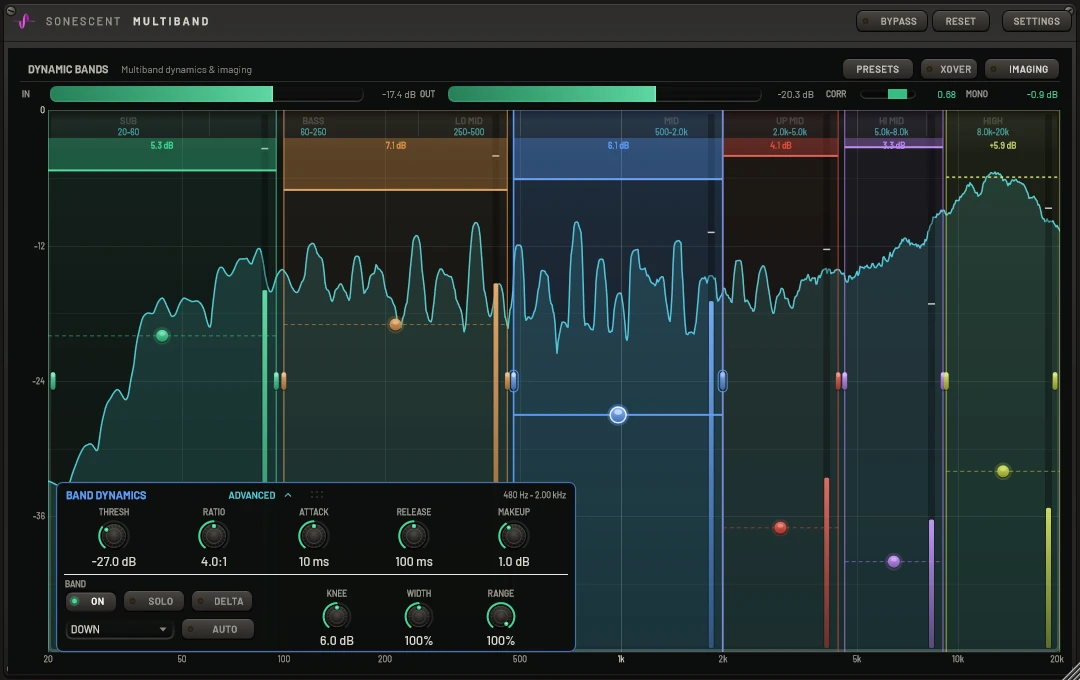
Every band has its own low and high edge, so a band is exactly as wide as the problem: 20 to 111 Hz for a boomy sub, 4 to 10 kHz for a harsh vocal. The compressor adds a correction only for the ranges you placed; where there is no band, the output is the input, sample for sample. Up to eight bands, all zero latency. When you want the other model, XOVER rebuilds the signal from a Linkwitz-Riley crossover at your band edges instead: full-depth gain right up to each split, at the cost of phase rotation across the whole signal. Both are honest about what they do, and you pick.

DOWN is classic compression. UP lifts quiet content in the band toward the threshold, capped by DEPTH so a noise floor can never be hauled up with it. SQUEEZE does both, and the UP and DOWN amounts scale each direction on its own, so a gentle lift under a firm cut is one band, not two plugins. The lift is driven by a peak follower rather than the raw waveform, which is why a steady tone gets a steady lift and not a pumping one. AUTO gives each band a program-dependent release: fast and slow recovery stages blended by the band's own crest factor and depth.

Each band has its own EXT switch. Key a band from the sidechain input and its detector hears the key signal through that band's own filters, so a kick ducks the bass band and leaves the vocal band alone. Nothing routed yet? The band falls back to its own signal, silently. SOLO hears one band's range; DELTA plays only the gain change that band is making, which is the fastest way to hear whether it is doing what you think.

ESS narrows what the band's detector listens to: a focus frequency and width inside the band, with a sensitivity offset, so a 4 to 10 kHz band can react to sibilance at 6.5 kHz without compressing every consonant around it. DETECT analyses the incoming signal once and sets the focus for you; LISTEN plays exactly what the detector hears so you can check its work. The audio band itself is unchanged; only the ears of the compressor move.

The same engine that runs the multiband stage in Cartigraph, taken out on its own and extended. Nothing here is named after gear it imitates; every control does one thing you can see on the plot.
Width from mono to 200% on each band, a mono-maker that folds everything under a chosen frequency to mono, and MONO SAFE, which stops any widening from pushing correlation negative.
Correlation and mono-sum loss measured at the output, after width and the mono-maker, so the cost of a stereo move is on screen where you make it.
A fourth-order Linkwitz-Riley tree split at your band edges, allpass-compensated so unity bands sum flat. Still zero latency.
Each band draws its reduction from the top and its lift as a marker, over a live spectrum and a per-band level meter, so a pumping band is visible before it is audible.
Zero to 12 dB of knee on every band, from a hard hinge to a gradual onset that stays transparent on dense material.
Factory starting points that leave every move visible on the plot, your own presets as files, and 64 steps of undo across bands, placement and imaging.
Click above a band to split it where you point; drag edges, drag the threshold node, drag a whole band. The spectrum reads like a reference analyzer, not a decoration.
Hover any control for a plain-language card describing what it actually does, including the honest tradeoff behind XOVER. Turn them off when the plugin feels like home.