Dynamic multiband
Click the spectrum to drop a band that compresses only its own frequency range. Up to 8 bands with imaging tools: mono-maker, M/S solo, and mono-safe width cap.
Compare your mix to pro tracks and your past self, at the same time, always loudness-matched. Cartigraph is the referencing plugin. Cartigraph Suite adds the full mastering chain and a rack for your own plugins.
Ten minutes on loudness bias: why the louder version always wins, and how snapshots and loudness-matched comparison give you a fair listen.
Want every feature? Watch the full walkthrough · Start the free 30-day trial · Read the guide
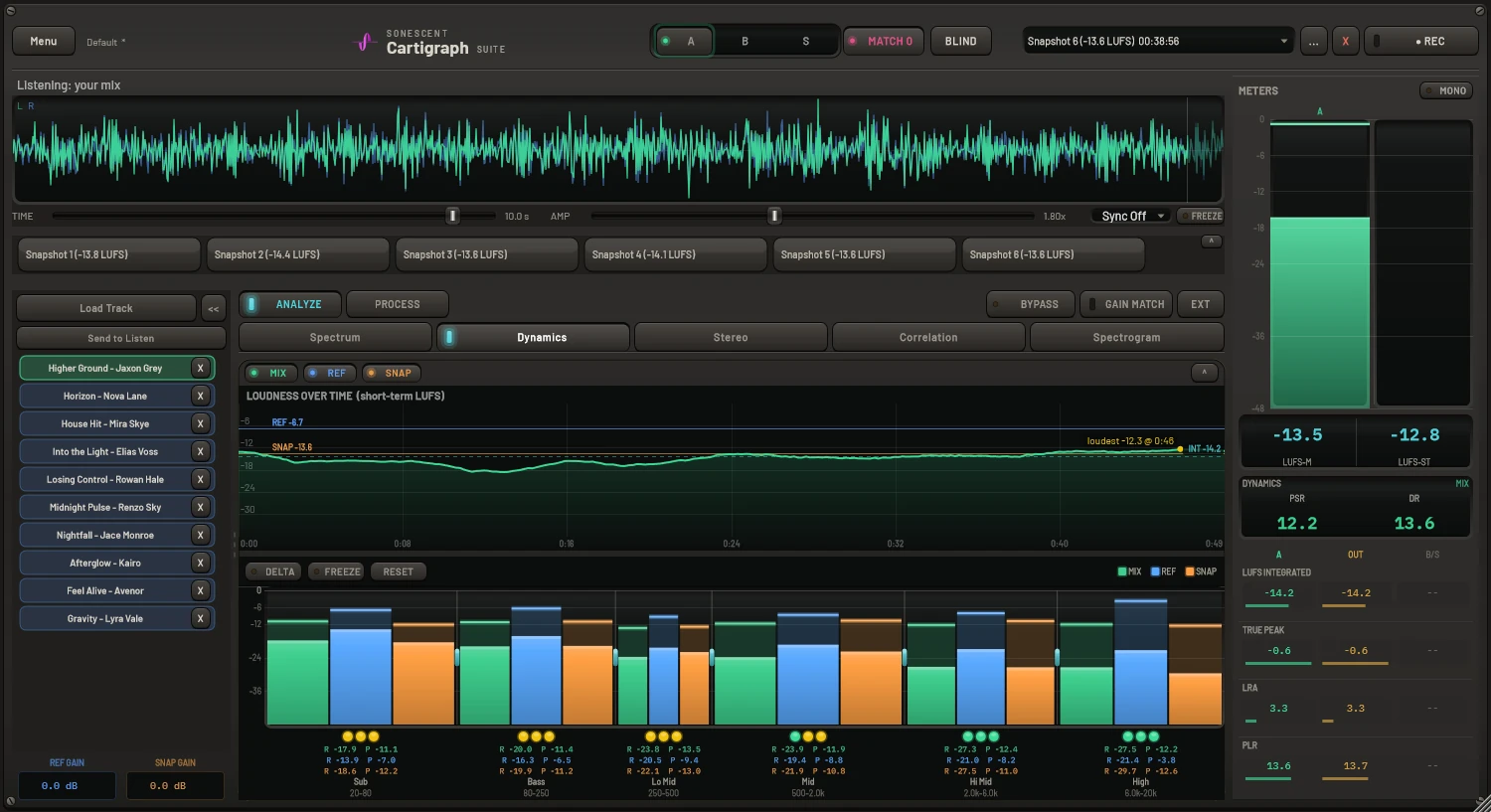
Switch between your live mix, a reference track, and a saved snapshot in one keystroke, loudness-matched so you're judging tone, not volume. BLIND mode randomly assigns mix vs. snapshot to two unlabeled buttons: pick the one that wins, then hit Reveal. ABX mode runs a significance test and tells you whether you can actually hear the difference, or whether you're guessing. No more "louder = better" fooling yourself.

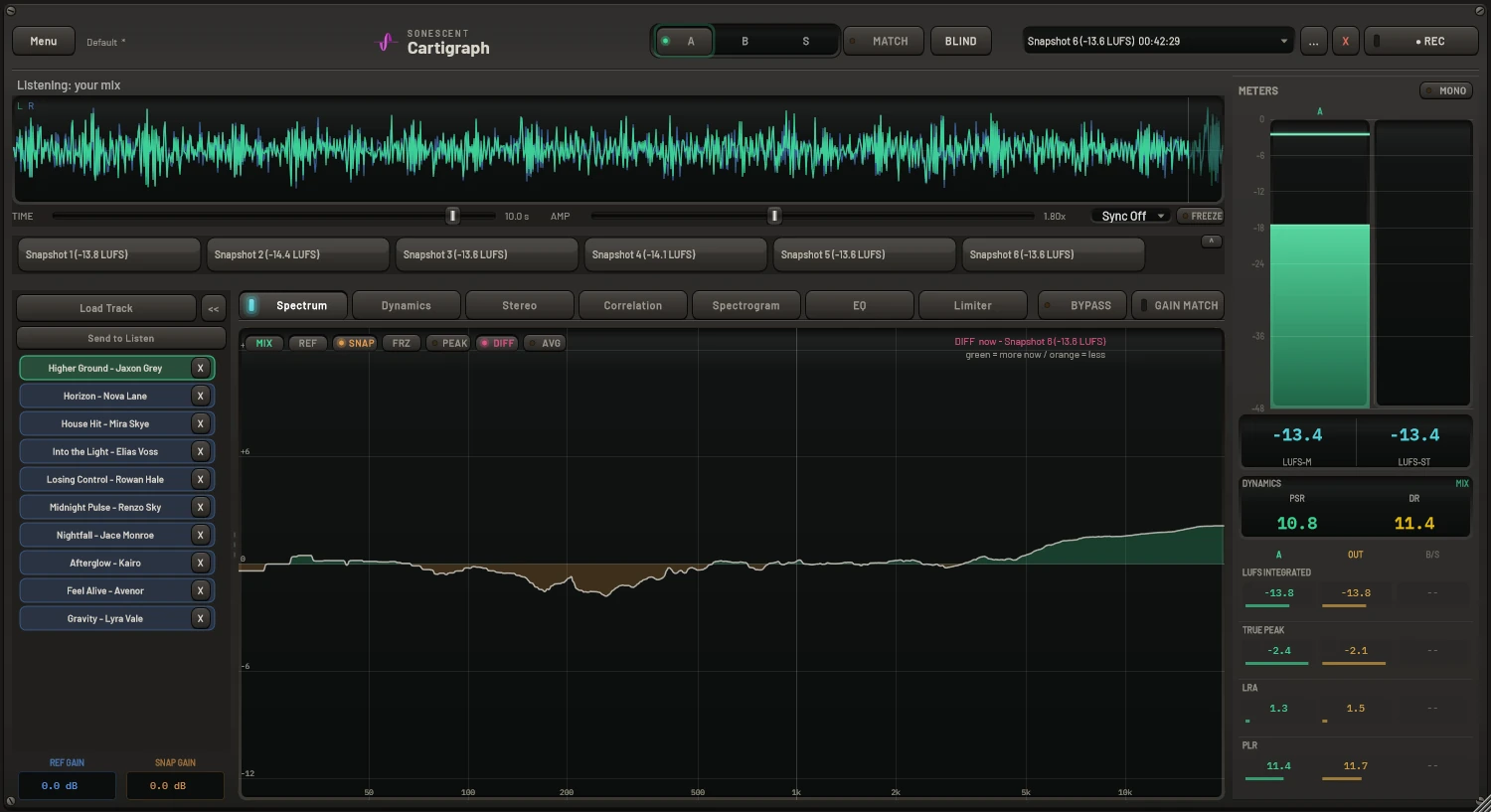
Save a snapshot before any risky move. Cartigraph freezes up to 3 minutes of any section of your mix (no bouncing, no re-importing) and stores it with your DAW session so it comes back when you reopen the project. Pull any of up to 32 snapshots up against your current mix or reference, instantly, and see the difference spectrum: exactly where energy moved between revisions instead of eyeballing two overlapping curves.
Every license includes Cartigraph Listen: a private listening library that syncs straight from the plugin to your phone. Send the snapshot you're working on, or any track you've exported, and hear it on earbuds, in the car, on the kitchen speaker. No bouncing to a folder, no AirDrop, no Dropbox link.
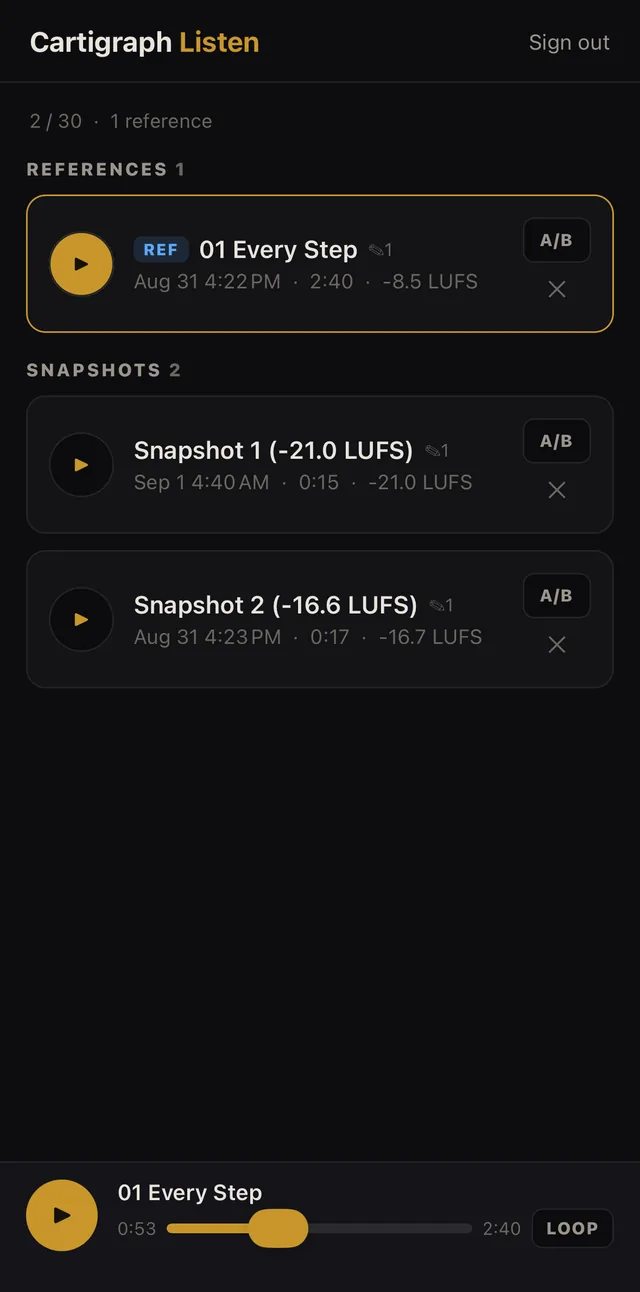
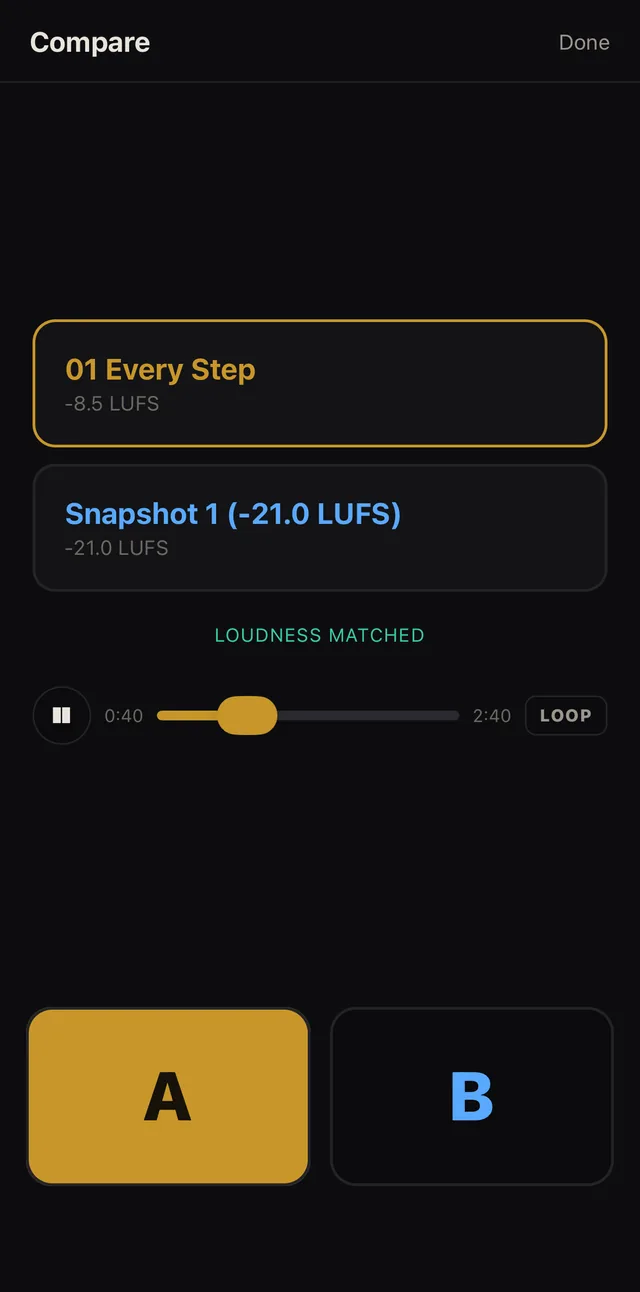
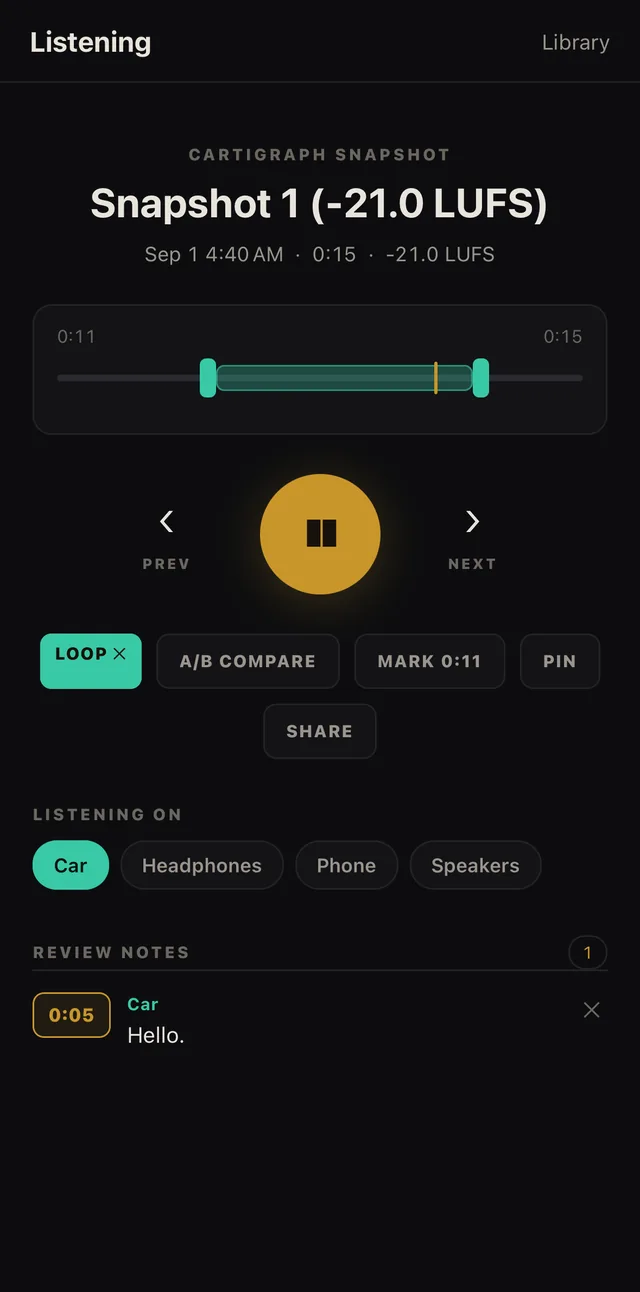
The snapshot … menu sends the current snapshot, or any file you've exported from your DAW: WAV, AIFF, FLAC, OGG, MP3, up to roughly 15 minutes of stereo.
Audio is encoded to FLAC and uploaded in the background. Open sonescent.com/listen on your phone and it's already waiting. New uploads appear on their own, no refresh.
Enter your license email, tap the link in your inbox, and stay signed in for 30 days. Add it to your home screen and it opens like an app, or get the native iPhone app from the App Store. Android is coming.
Five analysis views (spectrum, dynamics, stereo image, correlation, and spectrogram), all with simultaneous MIX / REF / SNAP overlay in colour-coded channels. The loudness arc plots short-term LUFS across the entire track as it plays, so you can confirm your drop actually hits harder than the build. Resonance detection flags the frequencies that ring and build over time. Click any flag to audition it.

The Suite adds seven processing stages, drag-to-reorder, all transparent until engaged. Leave it on the master bus all session as a pure analyzer, then engage the chain when you're ready to finish. Cartigraph includes the dynamic EQ and a simple true-peak limiter from this list, for checking a mix at a mastered level.
Click the spectrum to drop a band that compresses only its own frequency range. Up to 8 bands with imaging tools: mono-maker, M/S solo, and mono-safe width cap.
Classic VCA bus compressor with side-chain high-pass, parallel mix, and switched ratios. Binds the mix without killing the kick.
Up to 24 bands. Any node can move only when the signal crosses a threshold. Per-band M/S/L/R placement. Resonance detection built in.
Five characters (Soft, Tube, Tape, Transformer, and Tape Machine) with drive, mix, bias, tone, and a high-pass to keep the low end clean. 4x oversampled.
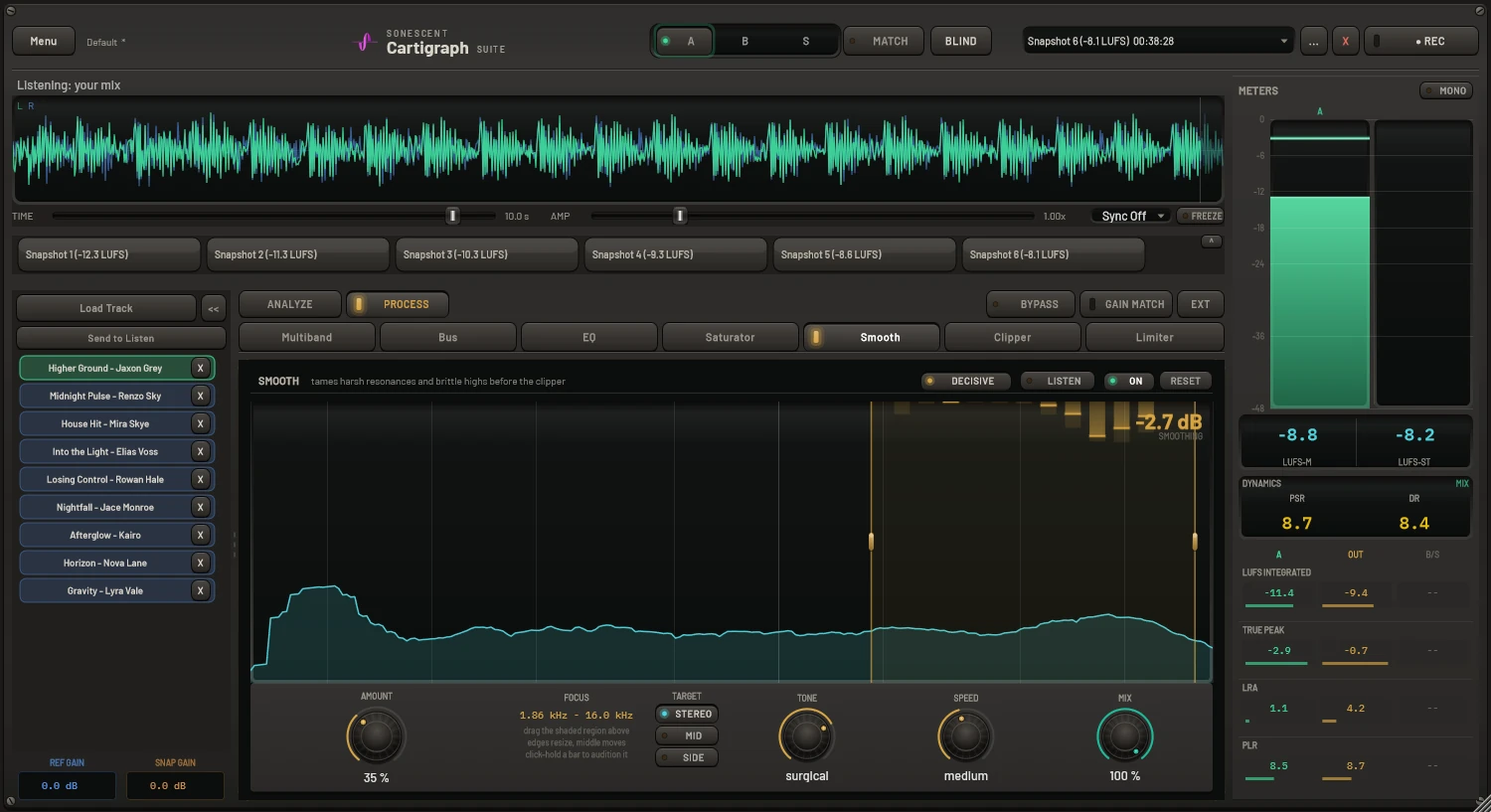
28-band dynamic resonance suppressor. Tames harsh frequencies before the clipper emphasises them. Reduction hard-capped at 12 dB per band so it can't dull a master.
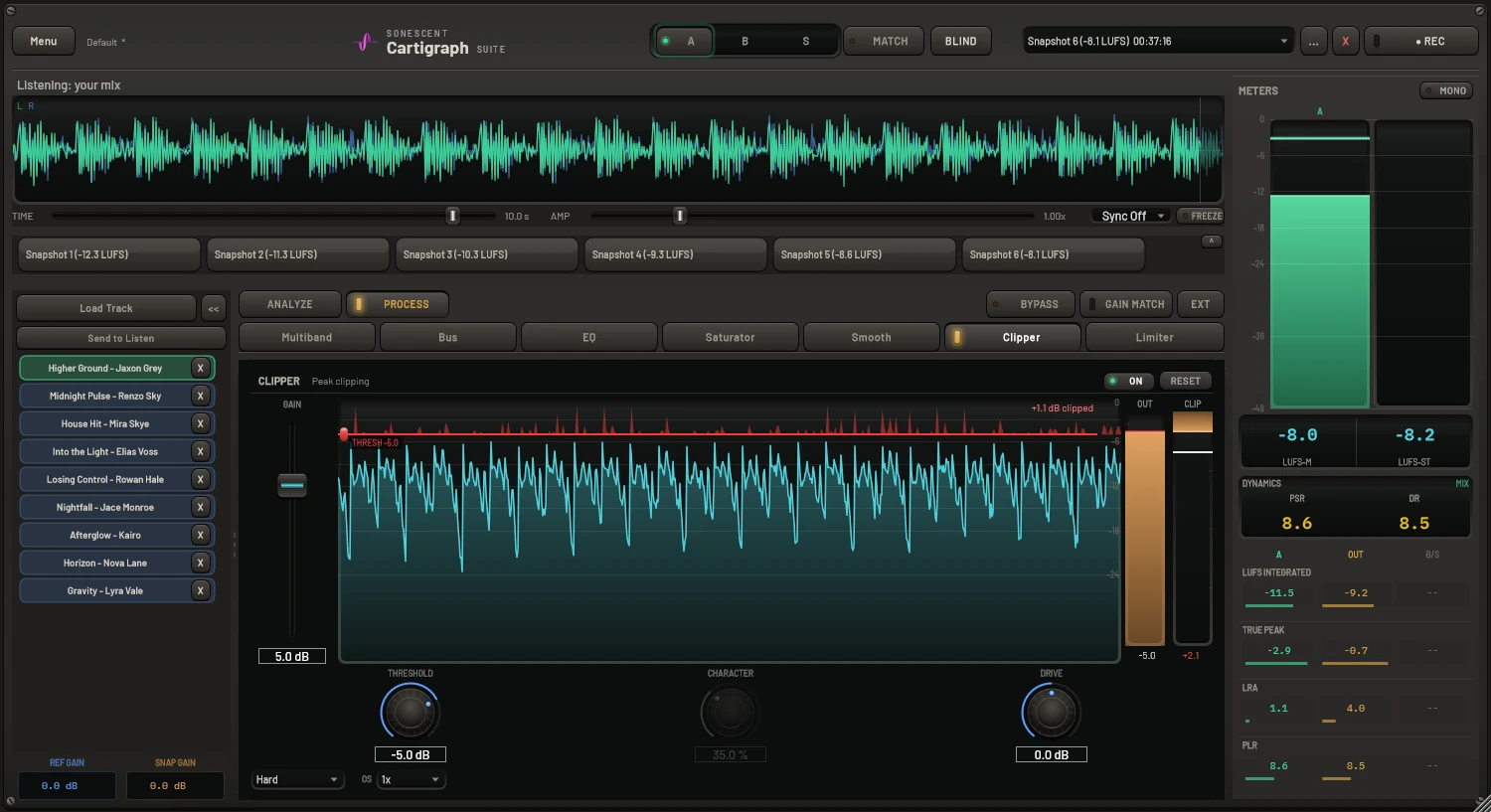
Transparent peak control before the limiter. Soft, Hard, and Distort modes, draggable threshold line, up to 8x oversampling.
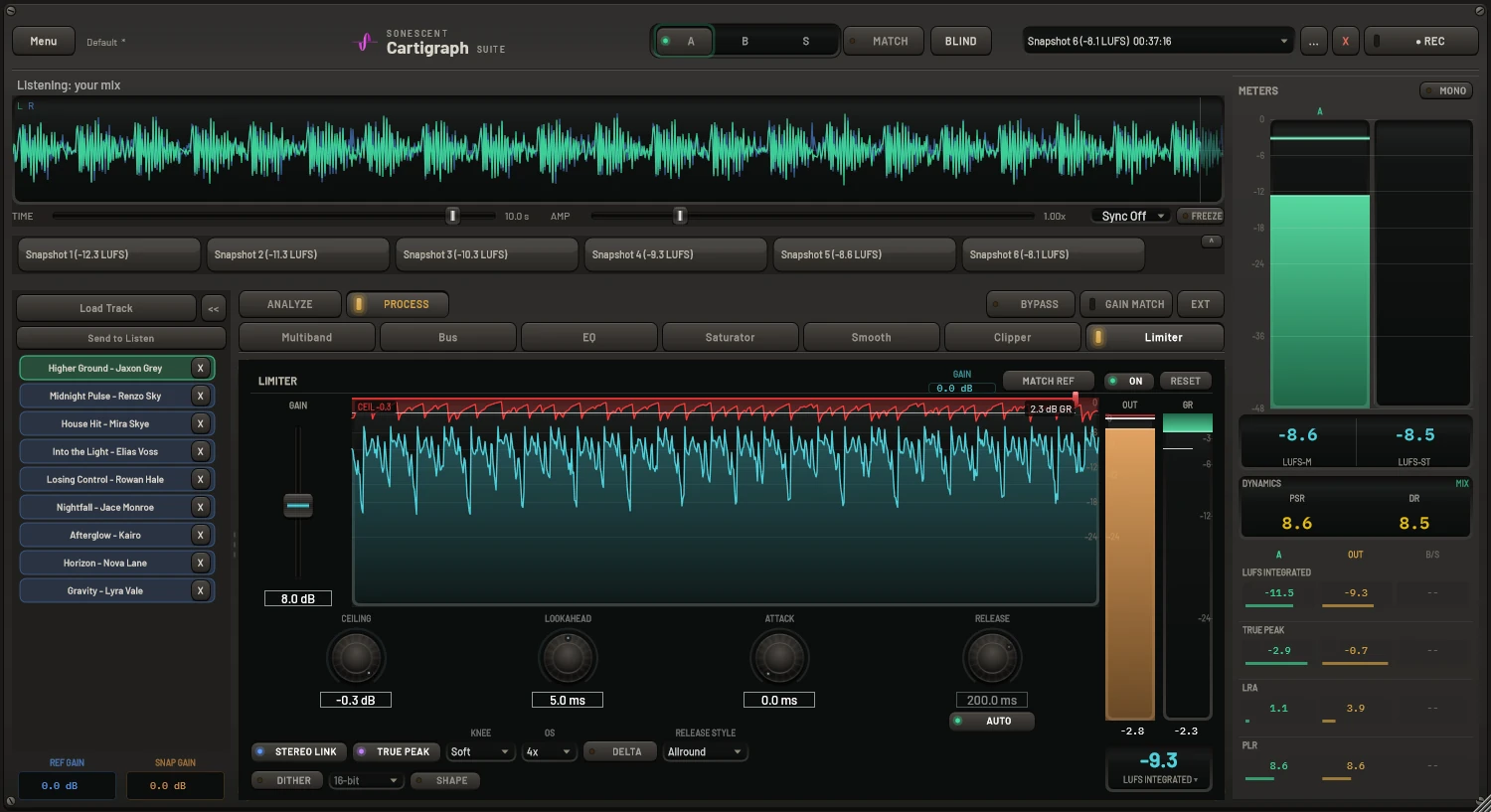
Brickwall limiter with lookahead, inter-sample peak handling, gain match, and reference loudness matching. Draggable ceiling line.
TPDF dither with optional 2nd-order noise shaping, always last in the chain. For 16 / 20 / 24-bit export.
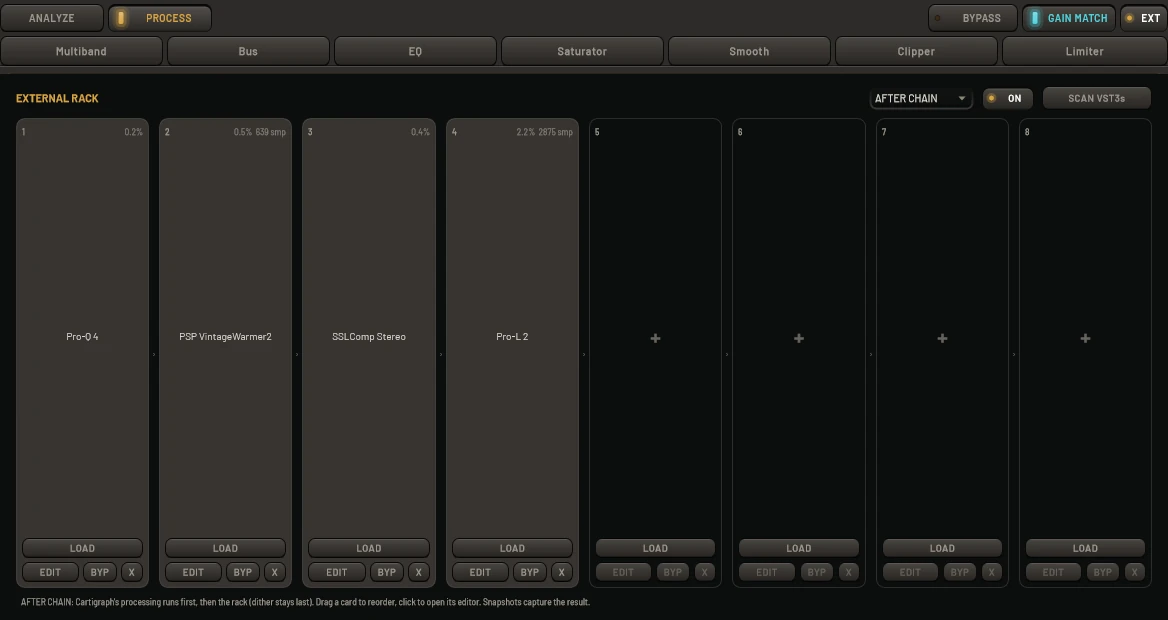
Eight slots for your favorite VST3s, hosted inside Cartigraph Suite. Put your go-to EQ, compressor, or limiter before or after the built-in chain, or replace the chain entirely. Everything you load gets the same gain-matched, sample-aligned before/after, shows its cost per slot, and is captured by snapshots like everything else. Drag cards to reorder. Dither always stays last.
Cartigraph for judging a mix honestly. Cartigraph Suite adds the full mastering chain and the External Rack. Each has its own free 30-day trial.
Both tiers can be rented to own: a fixed number of monthly payments and the license is yours forever, with the same 3 machines and every update. Cancel any time: access runs to the end of the month you've paid for, and every payment stays credited to you if you come back later. Billed monthly by Paddle, and the plan stops on its own after the last payment.