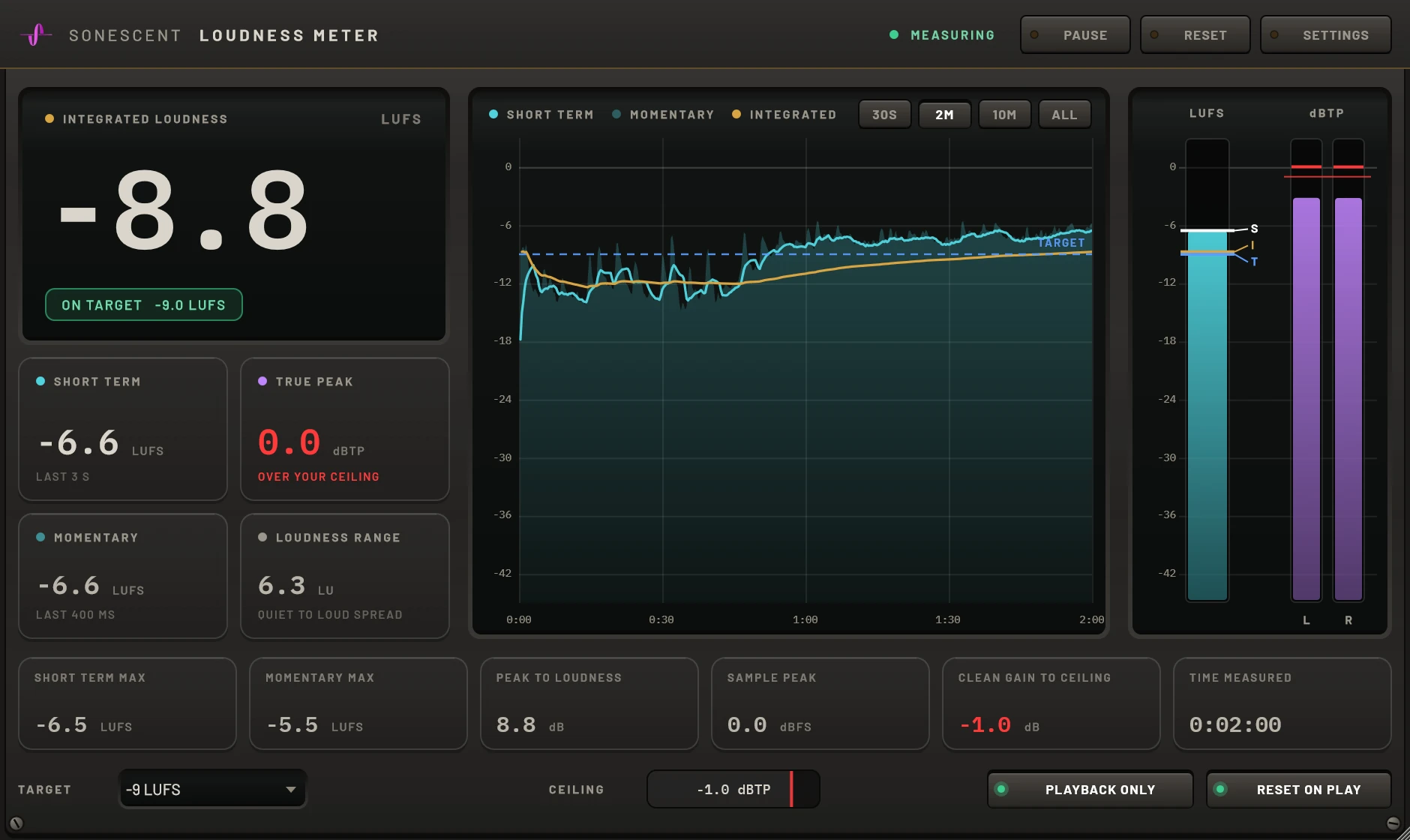
The three numbers first
Integrated loudness is the hero. Short term (the last 3 seconds) and true peak sit next to it. Momentary, loudness range, sample peak, peak to loudness ratio and the held maxima are all there, one row down, out of the way.
Loudness over time
The graph draws short term, momentary and integrated loudness across the pass you just played, so you can see how far the drop sits above the breakdown. It shares one vertical scale with the meters, and it uses a fixed amount of memory however long the session runs.
True peak at 8x
True peak is measured on a copy of the signal interpolated 8 times at 44.1 and 48 kHz (4 times at 96 kHz). On a worst-case test tone it reads within about 0.1 dB of the real peak, where a 4x detector can miss by several tenths. It never reads below the sample peak.
Measured to the standard
Loudness follows ITU-R BS.1770 with gated integration, and loudness range follows EBU Tech 3342. The weighting filter matches the published ITU coefficients, including the low end, which is where bass-heavy music is won or lost. We run the tone-based EBU test signals against every build.
A target that stays honest
Pick a reference level, or type your own, and the meter shows how far above or below it you are. It is a line you chose, not a rule: a fresh instance has no target at all, and nothing on the screen tells you what loudness you are supposed to hit.
It never touches your audio
The plugin does not write to the audio it receives, in 32 or 64 bit hosts, so what comes out is bit for bit what went in, with zero latency. It has no license key, no account and no network code. It does not connect to anything.