Lookahead
Zero to 10 ms. The detector sees each peak before it arrives and eases the gain down ahead of it, so the ceiling is met by a gain curve instead of a clip. Latency is reported to the host to the sample.
A true-peak mastering limiter that draws the signal you are driving into it, the output it let through, and, in red between them, everything it took. Bypass and loudness match sit side by side at the top, so what you judge is the limiting and not the level.
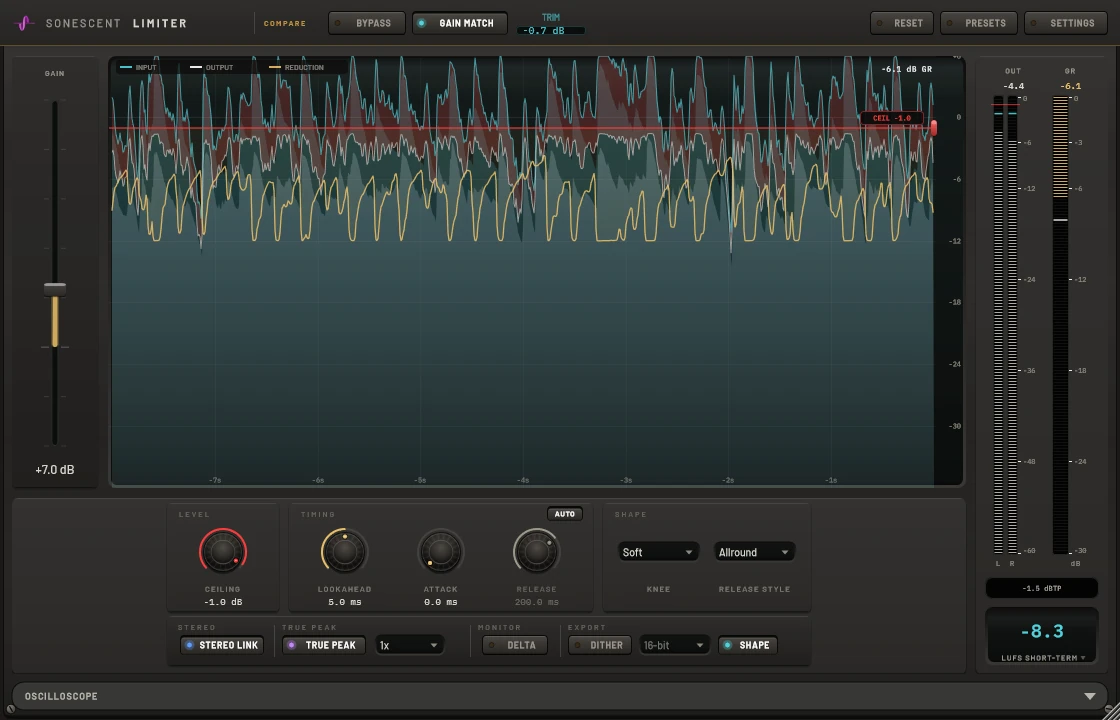
The teal envelope is the signal as the limiter sees it, input gain included, so it climbs over the ceiling line as you push. The white envelope is the output, which cannot cross that line. The red between them is what was removed: the tops of the peaks it caught, and the dip in the bed right after each hit, which is the release doing its work. The gold line is the gain reduction, so you can see how far each hit was pulled down and how fast it comes back. Drag the red line to move the ceiling. A limiter's whole job is the gap between those two curves, and this is the plugin that draws it.

One release time cannot both keep a transient's punch and hold a sustained chord clean, which is why single-stage limiters pump or dull at six to ten decibels of reduction. ALLROUND and PUNCHY use a dual-timescale release inside one gain follower: the gain comes back fast right after a peak, then eases into a slow asymptote, with a short hold stage and a windowed peak-hold detector so the gain never dips between close hits. CLEAN is the classic single stage when that is what the material wants. AUTO makes the slow stage program-dependent, slowing on dense material and speeding up on sparse. ATTACK shapes the front of each hit inside the lookahead window.

Clamping samples to a ceiling does not bound the waveform a converter reconstructs between them. With TRUE PEAK on, the limiter runs at 16x oversampling through linear-phase halfband filters, so the peaks between the samples exist where the gain ride can see them, and nothing rings back up on the way down. The margin it keeps under the ceiling is adaptive: it measures the output's own true peak every block, jumps up the instant that approaches the ceiling, and releases back toward a 0.3 dB floor on benign material. A fixed worst-case margin would cost you loudness all the time; this one costs it only when the content demands it. The true-peak meter beside it is ITU-R BS.1770, and OVER latches red if the output ever crosses the line.

Louder sounds better, which makes an unmatched bypass useless for judging a limiter. BYPASS and GAIN MATCH sit together in the header, because together they are one control: the match measures short-term loudness in and out and pulls the output down to the input's level, so in and out of circuit compare the limiting itself. The trim holds across the bypass and freezes for a few seconds each time you come back, so the A/B is instant and level-identical rather than drifting while the meters refill. Bypassed is a monitoring state, not an off switch: every control stays live and the display keeps drawing the limiting you are not currently hearing. DELTA plays only what was removed: clicky tips mean clean limiting, crackle means the gain is moving too fast. The big loudness figure switches between momentary, short-term and integrated, and can reset itself every time you press play. The meters always read the true output, before the match trim.

The same limiter engine that runs the mastering stage in Cartigraph, taken out on its own. Nothing here is named after gear it imitates; every control does one thing you can see on the display.
Zero to 10 ms. The detector sees each peak before it arrives and eases the gain down ahead of it, so the ceiling is met by a gain curve instead of a clip. Latency is reported to the host to the sample.
Hard, or limiting that eases in over 1, 2 or 4 dB below the ceiling. Hard is loudest; the wider knees trade a little level for a gentler onset on dense material.
One gain for both channels so the image never shifts when one side is caught, or independent per-channel limiting when you want each side to keep its own level.
1x to 32x, with the true-peak path never running under 16x. A hard clamp at the ceiling remains the guarantee whatever the setting.
TPDF dither with second-order noise shaping for the final bounce, at 16, 20 or 24 bits, applied last so the host's truncation is lossless. Off until you turn it on.
Gain reduction, BS.1770 loudness and true peak, measured after the limiter and before the monitor trim, so the numbers are what leaves the plugin. The OUT meter follows what you actually hear.
A bank of factory starting points that set the controls and get out of the way, your own presets as files, and 64 steps of undo over every sound-shaping move. No delivery-target presets: the ceiling and the gain are yours to set against your own ears.
Hover any control for a plain-language card describing what it actually does, including the headroom the true-peak margin is costing you right now. Turn them off when the plugin feels like home.