Width you can see
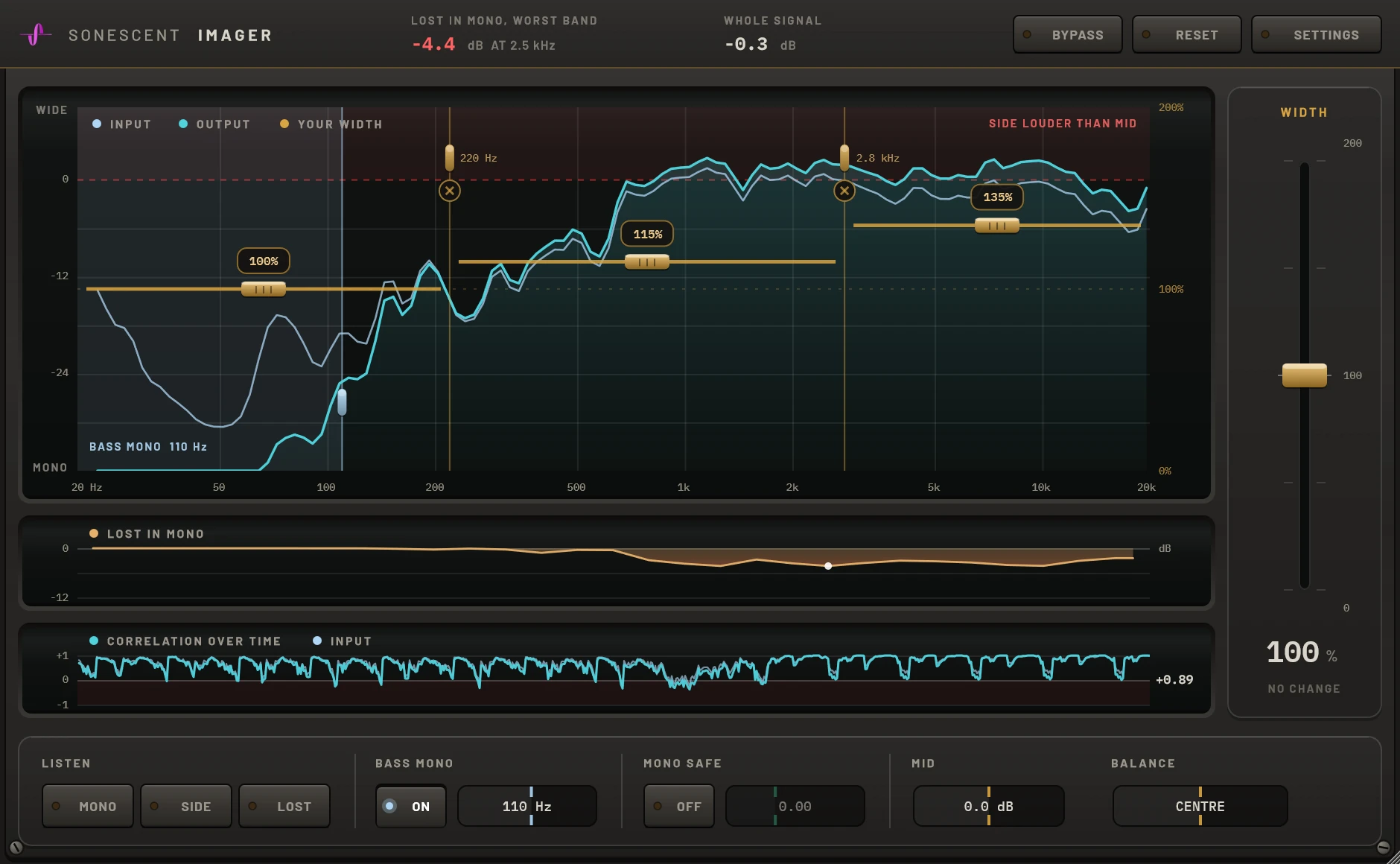
The main display draws how wide the sound is at each frequency: grey for what comes in, teal for what goes out. Low on the display is mono, high is wide. You can see that the bass is narrow and the hats are wide before you touch anything.
What mono costs, in dB
Under it, on the same frequency axis, the LOST IN MONO line shows how many dB each third-octave band drops when left and right are summed. The header names the worst band and where it is. It updates as you widen, so you see the cost before you commit.
One fader, or up to four bands
The WIDTH fader can be the whole plugin: 100% leaves the image alone, 0% is mono, 200% doubles the side signal. Double-click the display to split it into up to four bands, each with its own gold bar to drag.
Bass mono and MONO SAFE
BASS MONO turns the side signal down below a frequency you choose, at 24 dB per octave. MONO SAFE holds each band's width back so the correlation between left and right settles at or above a floor you set, and the display shows in green where it is holding a band back.
Listen to what is lost
LISTEN MONO plays the output the way a single speaker would. LISTEN SIDE plays what the width controls act on. LISTEN LOST plays the stereo output minus its mono sum, which is exactly the part a mono speaker drops.
Plain about what it does
With every control at its default the output is the input, bit for bit, and the plugin adds no latency at any setting. With several bands, or with BASS MONO on, a changed setting sends the signal through a crossover that keeps the level flat and shifts the phase, as a zero-latency crossover does. No license key, no account, no network code.